 |
| Heating, cooking, and drying things all at once This time of year, our house can get to be too hot by mid-afternoon, and stay too hot for a comfortable sleep early in the night. By morning, it's always lovely and cool, because our altitude causes a dramatic temperature drop overnight. We hate to lose our blissfully cool interior, so we try to keep our cookstove use to an absolute minimum. I'm usually the first one up in the morning. I light a fire to heat hot water for the day. While the fire is going, I try to do as much as I can. First, of course, I make coffee. Then, I cook whatever I can for the day: things that can be eaten cold later, like potatoes for salad, or a roast for sandwiches. By that time, the oven is hot and I can put a loaf of bread in if necessary and let the fire burn out. The hot water can be used for dishes and bathing, then refilled so the dying fire can heat more for the rest of the day. In the evening, we use a barbeque, outdoor cookstove, or propane stove to do any cooking that still needs to be done, like a steak or chop. In a really hot spell (which doesn't usually last very long here), we use the outdoor stove or propane for water, too, but that's a lot more work. |
Showing posts with label utilities. Show all posts
Showing posts with label utilities. Show all posts
Saturday, August 6, 2011
Morning cooking

Sunday, April 10, 2011
Thermoelectricity
Signs of spring: Our pond is full, so Tobias can finally swim a bit, though there's still lots of ice. The robins and thrushes have been back for a while.
A friend of ours bought a little fan that sits on his woodstove and circulates the warm air. He assumed that it operated simply because hot air rises. In fact, it has a small thermoelectric generator running it. I'd never heard of such a thing and started investigating. What I found out surprised me.
In very basic terms, it works like this: When a substance is heated unevenly, so that there is a difference of at least 60 degrees in temperature between one end of it and the other, an electric current is created. A denser material or greater temperature difference will cause a stronger current.
According to Collier's Encyclopaedia, thermoelectric systems are used on the moon, where the extreme temperatures make them very efficient. On a more everyday level: in the 1950's, small units were distributed to people living in remote Siberia so that they could use the heat from their kerosene lamps to run their radios.
It's really free electricity. I bet my cookstove could run a lightbulb and a radio through the winter if I had the knowledge to build a little generator. Too bad the makers of that fan wouldn't produce something slightly more powerful and more useful.
 |
| Tobacco seedlings, about 3 weeks old |
In very basic terms, it works like this: When a substance is heated unevenly, so that there is a difference of at least 60 degrees in temperature between one end of it and the other, an electric current is created. A denser material or greater temperature difference will cause a stronger current.
According to Collier's Encyclopaedia, thermoelectric systems are used on the moon, where the extreme temperatures make them very efficient. On a more everyday level: in the 1950's, small units were distributed to people living in remote Siberia so that they could use the heat from their kerosene lamps to run their radios.
It's really free electricity. I bet my cookstove could run a lightbulb and a radio through the winter if I had the knowledge to build a little generator. Too bad the makers of that fan wouldn't produce something slightly more powerful and more useful.
 |
| Dulsa still likes to lie in a basket |
Sunday, March 13, 2011
Refrigeration off the grid
Signs of spring: The first spring flowers are blooming. They are wind-pollinated, so they don't need to wait for the insects to come out.
Refrigeration off the grid isn't much of a problem in a cold climate like we have here in the Cariboo. It's even less a problem when your diet consists mostly of fresh food grown on your own farm.
Most people stuff their fridges full of leftovers and things that don't require really icy temperatures (like pickles and produce). As long as you eat any leftovers promptly, a cold room in the basement is enough refrigeration for most things.
Our cold room takes up the north third of our basement. It's three feet underground, with a dirt floor, and it's well insulated on all four walls as well as the ceiling. This keeps it isolated from the rest of the house as well as the outside, and the temperature stays pretty constant year-round, at a few degrees above freezing. There is a small vent to the outside to let cool night air in through the summer, and we can open a door to the heated part of the basement if it gets too cold in the winter.
Meat and milk are the two items that need colder temperatures. We hang our milk in a basket in the well to keep it cold. It's a time-honoured method. In mid-summer, even the well isn't cold enough to keep the milk fresh for longer than a couple of days, but when you have a constant supply of it fresh from the goat, there's no need to drink two-day-old milk anyway. We eat much more meat in the winter than in summer. In winter, the meat can simply be stored outside in a cabinet. Whatever we're going to store for summer use gets pressure-canned.
Occasionally, we use our propane fridge; for example, if we butcher and then are too busy to do the canning right away. Most years go by without our using it, though. We find it mostly to be an unnecessary expense.
 |
| Alder catkins |
 |
| Birch catkin |
 |
| Willow catkins |
Refrigeration Off-the-Grid
Refrigeration off the grid isn't much of a problem in a cold climate like we have here in the Cariboo. It's even less a problem when your diet consists mostly of fresh food grown on your own farm.
Most people stuff their fridges full of leftovers and things that don't require really icy temperatures (like pickles and produce). As long as you eat any leftovers promptly, a cold room in the basement is enough refrigeration for most things.
Our cold room takes up the north third of our basement. It's three feet underground, with a dirt floor, and it's well insulated on all four walls as well as the ceiling. This keeps it isolated from the rest of the house as well as the outside, and the temperature stays pretty constant year-round, at a few degrees above freezing. There is a small vent to the outside to let cool night air in through the summer, and we can open a door to the heated part of the basement if it gets too cold in the winter.
Meat and milk are the two items that need colder temperatures. We hang our milk in a basket in the well to keep it cold. It's a time-honoured method. In mid-summer, even the well isn't cold enough to keep the milk fresh for longer than a couple of days, but when you have a constant supply of it fresh from the goat, there's no need to drink two-day-old milk anyway. We eat much more meat in the winter than in summer. In winter, the meat can simply be stored outside in a cabinet. Whatever we're going to store for summer use gets pressure-canned.
 |
| Milk basket being lowered into a snow-surrounded well |
Occasionally, we use our propane fridge; for example, if we butcher and then are too busy to do the canning right away. Most years go by without our using it, though. We find it mostly to be an unnecessary expense.
Saturday, February 19, 2011
Heating
 |
| the first stove |
I love my cookstove. One of the reasons I can't imagine moving back to the city is that I'd have to leave it behind. That might break my heart.
Being a lazy person, I strongly approve of anything that accomplishes several objectives with one amount of work. I chop wood once. That same wood, via the stove, heats my house, fuels my cooking, dries my clothes, heats my water, makes my toast, dehydrates food for storage. I can slow-cook a stew or a roast, or do my canning, with no extra energy. How can you improve on that?


The first cookstove we had was one we bought for $75. It was an old, worn-out Enterprise brand, with a warming oven. We used it for several years when we first moved here. I liked the way we could have so many things on the stovetop at once, and it served us well, but it was so "leaky" that the fire was always either going full-out or just going out.
The firebox was so small that we had to cut the wood into tiny pieces and stoke it often, and it wouldn't hold a fire for even half the night. The house was cold by morning and during the winter months we needed to keep a second stove burning in the basement.
We finally wore that stove out completely and bought another used one. It was a much plainer model, with no warming oven. Being in better shape, it was more easily controlled, but basically still had the same problems. One advantage to having these two old stoves was that they taught me to judge my wood well. I had to know which kinds of wood burned hot, or burned for a long time, because it took finesse to get the oven to the right temperature or keep the house warm for as long as possible while we were in town or asleep.
Our current stove is everything those first two were not. It is an Amish-made model from Ontario. We bought it brand-new four years ago, for about $1200. It's that marvel of technology: an airtight cookstove. It has a nice, big firebox and also a big oven. The heat is easy to control. It holds a fire ovenight with no problem at all. Our house is always warm. We still need a stove in the basement to keep things from freezing down there, only when the temperature drops below -20. I'm looking forward to many happy years with this one.
 |
| our current stove |
Saturday, February 12, 2011
Lighting
 |
| Amber flame flickers A small luminous circle Soft darkness beyond |
We've used a few different light sources over the years. At first, we stuck to kerosene lamps and candles; and, after I became accustomed to doing things in the limited light, I liked them. The light that they give off is warm and appealing. There are two drawbacks to them, though. First, they give plenty of light close to the source but not enough to do any detail work even a few feet away. Second, and even more important, the price of both oil and candles has increased until it costs an unreasonable amount.
We found a 12-volt lamp that worked fairly well, but it drained the battery 'way too fast. Lately, we've started using a propane light. The quality of the light isn't as nice as the lamplight, but it's not too bad, and the one lamp illuminates the whole room. We still supplement it with the candles and oil lamps sometimes, but we're finding ourselves better lit at a quarter the cost using propane.
The propane tank is stored outside (because I'm paranoid about leaks), and the gas is piped in to the lamp. One twenty-pound tank lasts about six weeks during the darkest part of winter. In summer, we cook with it on hot days, and it still lasts about three months.
 |
| The propane light |
Saturday, January 15, 2011
Marion's Lazy Water System

We use the simplest water system possible. Charles used crossed sticks and also his knowledge of landscape and vegetation to witch a well. A neighbour with a small backhoe dug a 12'-deep hole. After pumping it out and watching it refill over several days, we stacked four 3' sections of 4'-diameter, concrete well casings in the hole. Then we filled the area around the casing with rocks to increase the well's water-holding capacity.
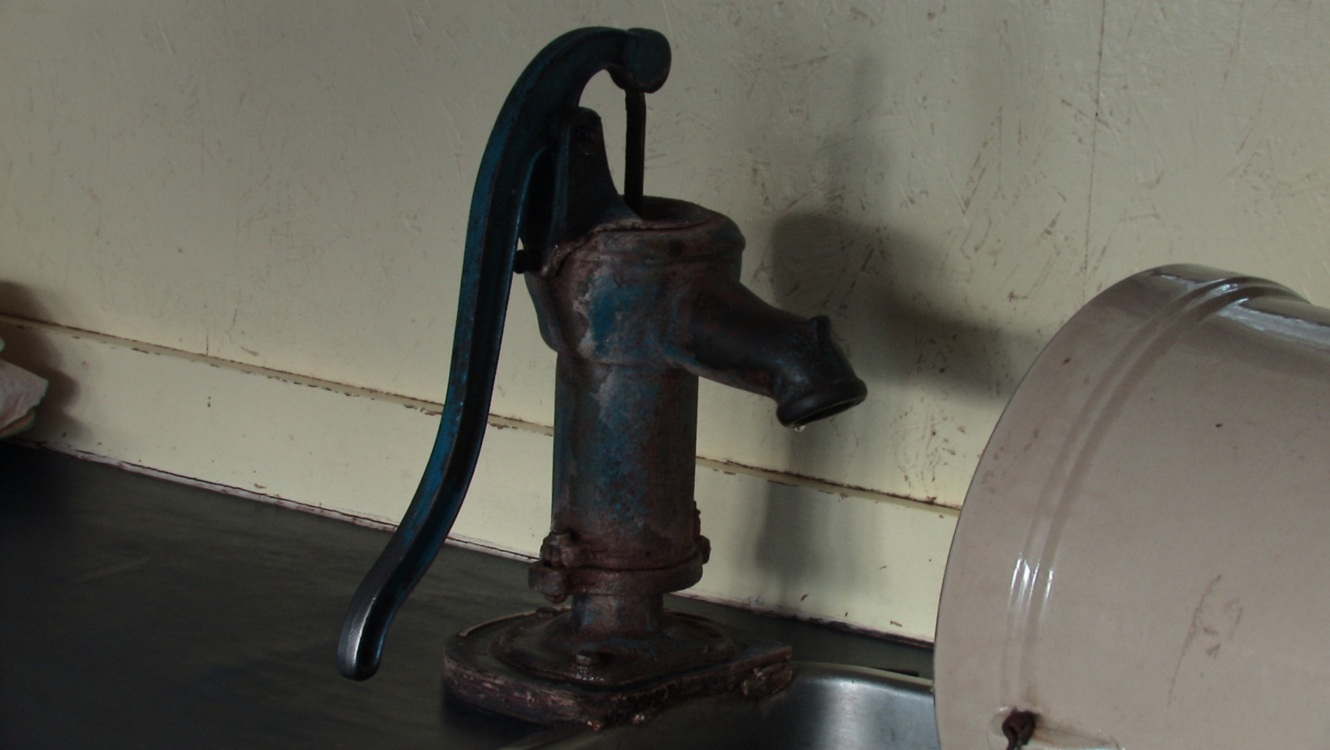
In the basement of the house, we have 3 connected 45-gallon drums. I fill them by carrying buckets of water from the well and pouring them into the barrels. Each barrel has a tight-fitting lid to keep out dust (and mice). Another pipe carries the water to a hand pump at the kitchen sink above. Presto - cold running water at the touch of a pump.
A drain leads from the sink to a rock pit outside. We're pretty careful about what goes down that drain.
A 5-gallon tank on the wood stove holds our hot water. In the winter, we refill it every time we use hot water for a constant supply. In the summer, our breakfast fire heats the water for our morning wash and the dishes, then it gradually cools so that by evening we're out of hot water. (For bathing in the summer, we have alternate methods, which I'll describe when it's summertime.)
About once a year, we add bleach to the water in the barrels and pump it through the system to clean it.
Here's why it's a "lazy" system:
- The installation cost was extremely low.
- There is no maintenance required.
- It never breaks down or freezes.
- It requires no power supply.
- It only takes me about 15 minutes a day to haul water, and this keeps me in good shape. I enjoy being outside, I play with the dog while I'm filling buckets, and I don't need to do any "weight-bearing exercises" to prevent osteoporosis.
Subscribe to:
Posts (Atom)